
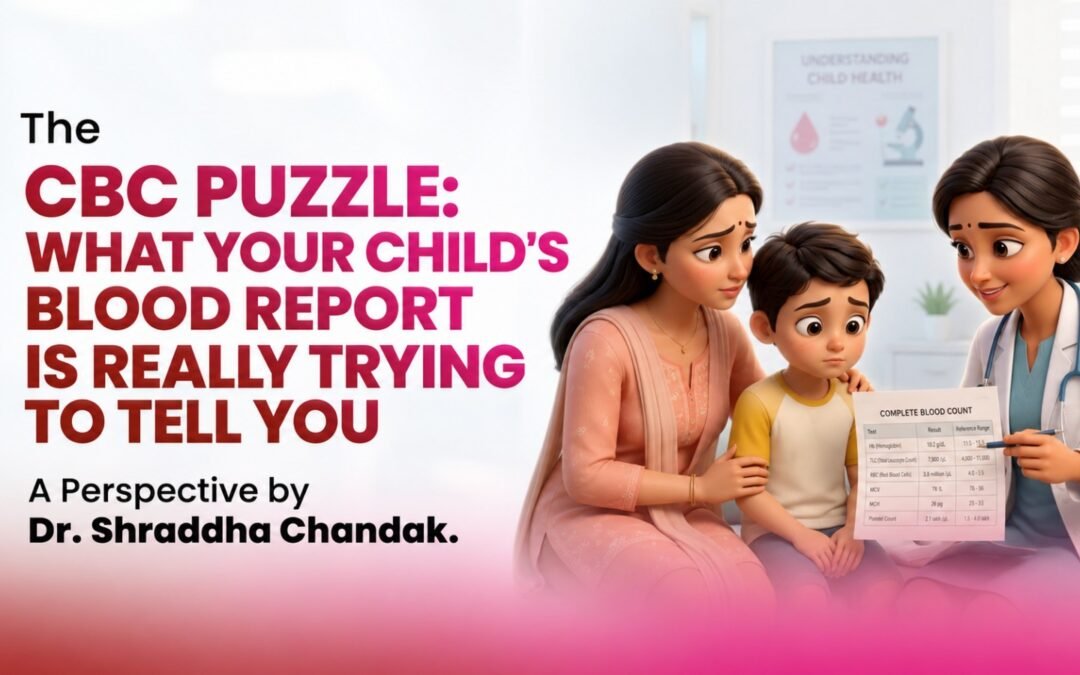
The CBC puzzle: what your child’s blood report is really trying to tell you is something many parents start wondering the moment a blood test lands in their WhatsApp inbox. Hemoglobin: low. Platelets: normal. WBC: slightly high. Suddenly, a simple report looks like a secret code. But here’s the reassuring part: a CBC test for children is not meant to be read as a collection of scary numbers. It is a picture of how different parts of your child’s blood are behaving.
What is a CBC test?
A complete blood count (CBC) is one of the most commonly ordered blood tests for children. It measures several important components, including red blood cells, white blood cells, hemoglobin, hematocrit and platelets.
Each tells your doctor something different.
Hemoglobin gives clues about oxygen-carrying capacity and can help identify anemia in children.
White blood cells (WBC) are part of the immune system. Their numbers may change during infections, inflammation and several other conditions.
Platelets help the blood clot. A low platelet count in children can have many causes, while a normal platelet count does not automatically rule out every bleeding problem.
And then there is the differential count, which breaks white blood cells into types such as neutrophils and lymphocytes. This can provide additional clues about what is happening inside the body.
Does an abnormal CBC always mean something serious?
Not at all.
This is one of the most important things parents should remember when interpreting a child blood report.
Children’s blood counts can change with age, recent infections, medications, hydration and many other factors. A value marked “high” or “low” on a laboratory report does not automatically mean disease.
For example, a high WBC count in children may occur during an infection. Similarly, a mildly reduced hemoglobin level may point towards iron deficiency anemia in children, but the doctor may need additional information before deciding what it means.
This is why CBC interpretation in children should never be based on one number alone.
Why does the doctor look at the whole picture?
Think of a CBC like a puzzle.
One piece may be interesting, but it is the pattern that matters.
Your pediatrician may consider your child’s symptoms, age, growth, recent illness, medications, physical examination and previous reports alongside the CBC.
If there is concern about abnormal blood counts in children, the doctor may recommend further investigations such as a peripheral smear, iron studies, reticulocyte count or other pediatric hematology tests, depending on the situation.
Sometimes, the best next step is simply to repeat the CBC blood test after an appropriate interval.
When should parents take a CBC report seriously?
A single unusual result is usually not a reason to panic. However, medical evaluation becomes particularly important when abnormal blood counts occur along with symptoms such as persistent fever, unusual tiredness, unexplained bruising, frequent infections, pallor, weight loss, bone pain or bleeding in children.
Persistent or unexplained abnormalities may sometimes require evaluation by a pediatric hematologist or pediatric hemato-oncologist.
The aim is not to assume the worst. It is to understand the reason behind the numbers.
The most important rule: Don’t Google one number
If your child’s report says “low platelets,” “high lymphocytes” or “low hemoglobin,” resist the urge to search for the scariest possibility first.
Instead, ask:
“What does this result mean in the context of my child?”
That one question can turn a frightening report into a useful conversation.
Final Thoughts
A CBC report can look intimidating, especially when a number is highlighted in red. But remember—one number rarely tells the whole story.
Your child’s blood report is a collection of clues. The real meaning comes from putting those clues together with your child’s symptoms, age, medical history and examination.
So, the next time you receive a CBC report, don’t panic over a single “high” or “low” value. Instead, take it to your pediatrician and ask the most useful question:
“What is this report telling us about my child?”
Because understanding a blood report is not about memorising numbers. It’s about understanding your child.