
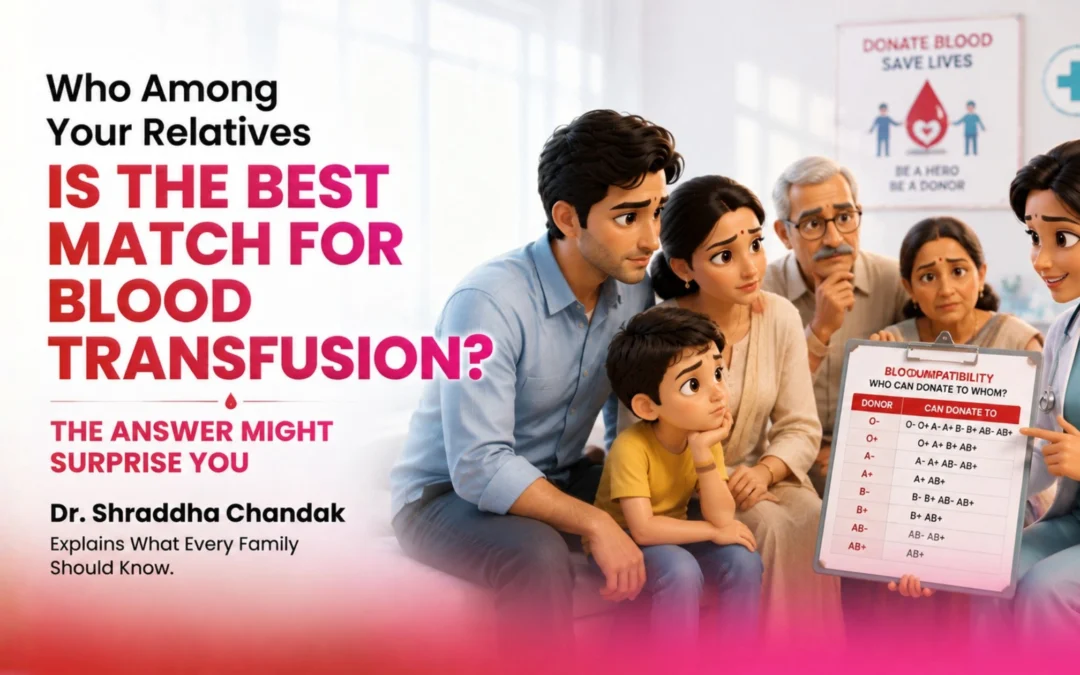
If you’ve ever had a loved one admitted to the hospital, chances are you’ve heard someone say: “Call the family members first. Their blood will match.”
It’s one of the most common beliefs surrounding blood transfusions—and one of the biggest misconceptions.
Many people assume that parents, siblings, or close relatives are automatically the best blood donors because they’re family. But in reality, blood transfusions don’t work that way.
In most situations, what matters is blood group compatibility, not family relationships. In fact, taking blood from relatives is often avoided unless there’s a very specific medical reason.
Confused?
Let’s clear up this common myth and understand who actually makes the best blood donor.
First Things First: What Is a Blood Transfusion?
A blood transfusion is a medical procedure where donated blood or blood components are given to a patient.
Doctors may recommend a transfusion for people with:
- Severe anaemia
- Blood cancers
- Thalassemia
- Sickle cell disease
- Major surgery
- Serious injuries
- Excessive bleeding during childbirth
- Bone marrow disorders
The goal is simple—to replace what’s missing and help the body function normally.
Does Being a Relative Mean Your Blood Is a Better Match?
No.
Being biologically related does not automatically make someone a better blood donor. Blood transfusions are matched based on:
- ABO blood group
- Rh factor (positive or negative)
- Crossmatching tests
- Presence of antibodies
- Sometimes additional blood group antigens for patients who receive frequent transfusions
A stranger with a compatible blood type may be a much better donor than a close family member with an incompatible blood group.
Then Why Do Families Rush to Donate?
It’s completely understandable. When someone is critically ill, family members naturally want to help. Many believe:
- Parents are the safest donors.
- Siblings are always the closest match.
- Blood from relatives is “stronger.”
- Family blood is less likely to cause reactions.
Unfortunately, none of these beliefs are medically accurate.
In Many Cases, Doctors Prefer Blood From Voluntary Blood Banks
This surprises many people.
Hospitals often prefer blood collected from licensed blood banks because it has undergone:
- Rigorous donor screening
- Infectious disease testing
- Blood grouping
- Quality control
- Proper storage
Voluntary blood donation systems are designed to provide safe and compatible blood for patients.
What About Siblings? Aren’t They the Best Match?
Not necessarily.
Brothers and sisters have a higher chance of sharing certain genetic traits, but that doesn’t guarantee compatible blood.
A sibling may have:
- A different blood group
- A different Rh type
- Different antibodies
Before every transfusion, compatibility testing is still essential.
Are Parents Good Blood Donors?
Again-not automatically.
Parents may or may not have compatible blood groups.
Even if the blood group matches, doctors may avoid using blood from first-degree relatives in some situations because of a rare but serious complication called Transfusion-Associated Graft-versus-Host Disease (TA-GVHD).
When Can Blood From Relatives Be Used?
There are situations where relatives may donate blood, such as:
- Rare blood groups
- Emergency situations
- Directed donations recommended by the treating doctor
Even then, the donated blood undergoes the same strict testing and compatibility checks as any other donation.
Who Is Actually the Best Blood Donor?
The best donor is someone who has:
- A compatible blood group
- Passed all donor eligibility criteria
- Tested negative for infections
- Successfully completed crossmatching
Notice that “being a relative” isn’t on this list.
Medical compatibility is what matters most.
What About Patients Who Need Frequent Blood Transfusions?
Some people, such as those with:
- Thalassemia major
- Sickle cell disease
- Certain bone marrow disorders
require repeated blood transfusions throughout life. For these patients, doctors often perform extended blood group matching to reduce the risk of developing antibodies against transfused blood. Again, compatibility matters far more than family relationships.
Final Thoughts
When someone you love needs blood, it’s natural to want to roll up your sleeve and help. But the safest blood isn’t determined by family ties—it’s determined by science.
Modern blood banking, compatibility testing, and careful screening have made blood transfusions remarkably safe. Whether the donor is a sibling, a parent, a friend, or a complete stranger, what truly matters is that the blood is compatible and has been properly tested.
So the next time someone says, “Only a relative’s blood will work,” you’ll know the truth: the best match is the one that is medically compatible, not biologically related.