
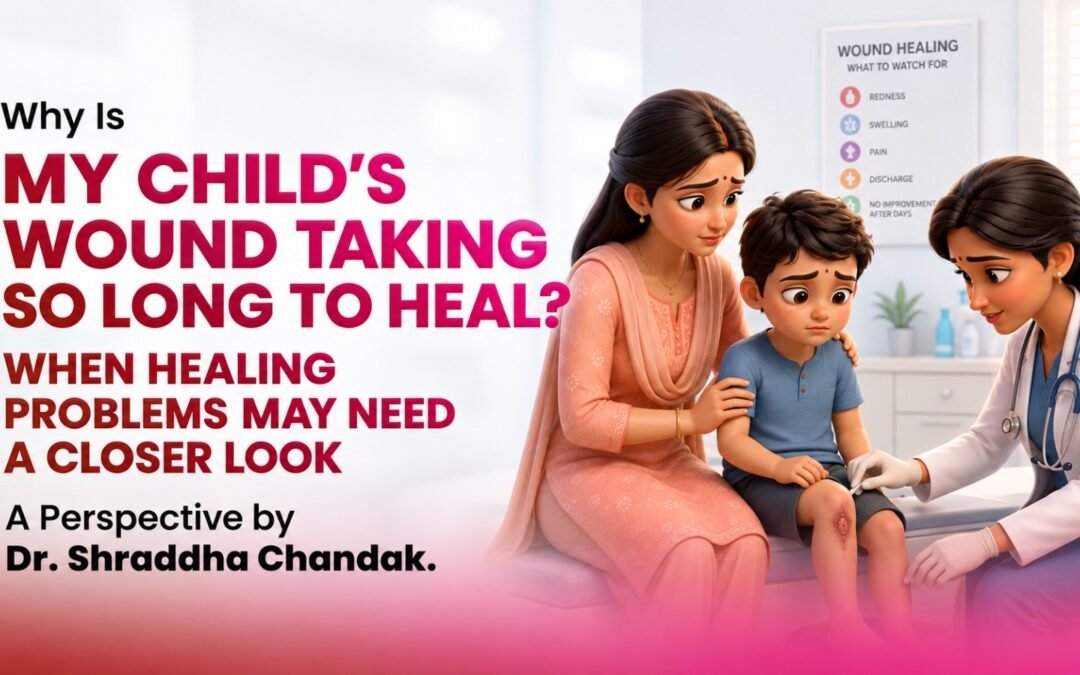
“Doctor, the wound is small, but why is it taking so long to heal?”
It’s a question parents often ask after a simple cut, scrape, insect bite, or minor injury refuses to disappear. Usually, slow wound healing in children is not a reason to panic. But when a child’s wound keeps reopening, becomes infected, or takes unusually long to heal, it can sometimes be a clue that something else needs attention.
So, why is my child’s wound taking so long to heal? Let’s break it down.
How long does a normal wound take to heal?
Children generally heal remarkably well. A small cut or scrape may begin improving within a few days and gradually close over the following days or weeks, depending on its size, depth and location.
However, wound healing in children can be affected by several factors, including infection, nutrition, blood circulation, repeated injury and certain underlying medical conditions.
That is why doctors look at the wound—and the child as a whole.
Why is my child’s wound not healing?
There isn’t just one answer.
1. The wound may be infected
Redness, swelling, increasing pain, warmth, pus or fever may suggest a wound infection in children.
A wound that initially looked better but suddenly becomes more painful or swollen deserves medical attention.
2. The wound keeps getting disturbed
Children are active. A wound on the knee, foot, elbow or hand may repeatedly get bumped, scratched or exposed to dirt.
Sometimes, what looks like delayed wound healing is simply a wound that hasn’t had enough time to heal properly.
3. Nutrition may play a role
Healing requires adequate protein, calories, vitamins and minerals.
Children with poor appetite, restricted diets, poor weight gain or nutritional deficiencies in children may sometimes heal more slowly.
4. There may be an underlying blood or immune problem
This is where doctors may need to look a little deeper.
If a child has recurrent infections, frequent skin infections, unusual bruising, persistent fever, significant fatigue, poor growth or wounds that repeatedly become infected, the problem may not be the wound itself.
Certain immune disorders in children can make it harder for the body to fight infections effectively.
Similarly, some blood disorders in children can present with symptoms that parents may not immediately connect to wound healing.
When should parents worry about a slow-healing wound?
A wound that is not healing deserves closer evaluation when:
- It shows no improvement despite appropriate wound care
- It repeatedly becomes infected
- It keeps reopening
- There is persistent pus or discharge
- The surrounding redness or swelling is increasing
- The child develops fever
- The child has multiple unusual or recurrent infections
- There is poor weight gain or unexplained tiredness
- There are other symptoms such as easy bruising or frequent bleeding
The combination of symptoms matters more than one wound alone.
What might the doctor check?
Your doctor may first examine the wound carefully and ask about how the injury happened, previous infections, nutrition, medications and your child’s general health.
If the healing problem seems unusual, investigations may include a CBC test for children, blood sugar testing, nutritional assessment or other blood tests.
If there are signs suggesting an immune deficiency in children, a pediatric immunologist may recommend additional immune-function testing.
The goal isn’t to order every test possible. It is to find the right clue.a
Can slow wound healing mean low immunity?
Sometimes-but not always.
A single slow-healing wound does not mean your child has low immunity.
However, if slow healing occurs alongside recurrent infections in children, frequent antibiotics, persistent fever, poor growth or unusual infections, doctors may consider whether an underlying primary immunodeficiency in children needs to be ruled out.
This is why the complete history matters.
Final Thoughts
Most childhood wounds heal beautifully with a little time, proper care and patience. So, a wound taking a few extra days to heal does not automatically mean something is wrong.
But when slow wound healing keeps happening, infections keep returning, or the wound is accompanied by symptoms such as poor growth, persistent fever, unusual bruising or frequent infections, it deserves a closer look.
The important thing is not to worry about one wound—it is to notice the pattern.
Sometimes, the wound is simply a wound. And sometimes, it is a small clue that helps your doctor understand something bigger about your child’s health.
When in doubt, don’t Google the worst-case scenario. Talk to your child’s doctor, look at the whole picture, and let the clues guide the next step.